
Are you hunting for the best USB C hub for multiple monitors to supercharge your laptop setup? These compact adapters transform a single USB-C port into a powerhouse, letting you connect several external displays, peripherals, and chargers all at once—perfect for productivity on the go or at your desk.
Thank you for reading this post, don't forget to subscribe!Modern laptops often skimp on ports, leaving you juggling adapters, dealing with flickering screens, or wrestling with compatibility headaches when trying to run dual or triple monitors. It’s frustrating when your workflow grinds to a halt because of laggy video output, insufficient power delivery, or unreliable connections that drop mid-meeting.
Choosing the right USB C hub isn’t just about adding ports—it’s about seamless multitasking that matches your needs, whether you’re a remote worker, designer, or gamer. A well-matched hub ensures crisp 4K visuals, stable performance across resolutions, and enough bandwidth to handle everything without compromise, saving you time and reducing tech stress in the long run.
We’ve carefully evaluated options based on key features like display support and port variety, real-world performance in diverse setups, feedback from everyday users, and overall value for money. Stick around as we dive into our top recommendations in the comparison table below to help you pick the perfect fit.
Best USB-C Hubs for Multiple Monitors 2026


Last update on 2025-12-21 / Affiliate links / Images from Amazon Product Advertising API
Read More:
- Engaging, keyword-optimized title under 60 characters (43 chars) with power words ‘Best’ and ‘Top Picks’, year for freshness, targeting user intent for recommendations.
- Best Ultralight Synthetic Sleeping Bags 2026
- Best True Wireless Sport Earbuds 2026
- Engaging, keyword-optimized title under 60 characters (43 chars) with power words ‘Best’ and ‘Top Picks’, year for freshness, targeting user intent for recommendations.
- Best Ultralight Synthetic Sleeping Bags 2026
USB C to USB C Hub Dual Monitor, USBC Splitter with 4K@60Hz DP Alt Mode Video Output, 10Gbps Data Transfer, 100W PD Charging, Dual Monitors Adapter for Laptop, Portable Monitor and More Type C Devices Review
Introduction
If you’re looking to expand your laptop’s connectivity without a bulky docking station, this USB C to USB C hub offers a compact solution for dual-monitor setups. It leverages DP Alt Mode to deliver sharp 4K@60Hz video output, alongside fast data transfer and power delivery, making it a practical choice for professionals and multitaskers with compatible Type C devices.
Key Features
- Dual 4K@60Hz Video Output: Supports two USB C monitors via DP Alt Mode 1.4, turning a single port into a multi-display workstation.
- High-Speed Ports: Includes two USB-C 3.1 ports at 10Gbps for quick data transfers and peripherals, plus a 100W PD charging port for pass-through power up to 87W.
- MST/SST Modes for Windows: Enables dual displays on Thunderbolt 4 or USB 4 laptops, ideal for extended desktops.
- Compact and Versatile: Works with portable monitors, Steam Deck, and other DP Alt Mode devices for on-the-go productivity.

Pros and Cons
- Pros: Crisp dual 4K resolution at 60Hz, reliable 10Gbps speeds, strong PD charging, portable design.
- Cons: Dual-monitor MST not supported on macOS, requires specific Thunderbolt 4/USB 4 compatibility, no included charger or cable.
Performance & User Experience
In everyday use, this hub shines for Windows users setting up home offices, delivering smooth video playback and responsive multitasking across two 4K displays. Data transfers feel snappy for external drives, and PD charging keeps laptops powered during long sessions. However, setup requires verifying DP Alt Mode support—non-compatible devices may limit it to single-monitor use. Stability is solid, with minimal lag in video or peripherals.
Who Is This Product For?
This hub suits Windows laptop owners with Thunderbolt 4 or USB 4 ports, such as Dell XPS or gaming rigs, who need dual USB C monitors for work, video editing, or coding. It’s also handy for Steam Deck users or those with portable displays, but macOS or older USB C systems should look elsewhere.
Final Verdict
A reliable pick for expanding USB C capabilities into a dual-monitor powerhouse, provided your setup matches the requirements. It balances performance and portability well, though compatibility checks are essential for satisfaction.
Anker Laptop Docking Station Dual Monitor, 8-in-1 USB C Hub, 4K Dual Monitor with 2 HDMI, 1 Gbps Ethernet Hub, 85W Power Delivery, SD Card Reader for MacBook Pro, XPS and More (Charger not Included) Review
Introduction
If you’re looking to transform your laptop into a full workstation, this Anker 8-in-1 USB-C docking station offers a practical solution. It connects multiple peripherals through a single USB-C port, supporting dual monitors and fast charging, making it ideal for users seeking expanded connectivity without clutter.

Key Features
- Dual HDMI ports: Handle one 4K@60Hz display or two at 4K@30Hz for extended desktops.
- 85W Power Delivery: Passes through charging to keep your laptop powered (requires separate 100W charger and USB-C cable).
- 1 Gbps Ethernet: Provides stable wired internet for reliable connectivity.
- SD/microSD reader and USB-A ports: Quick access to memory cards and peripherals.
- Wide compatibility: Works with MacBooks (macOS 12+), Windows, ChromeOS devices with DP Alt Mode.
Pros and Cons
- Pros: Compact design, dependable build from Anker, versatile port selection, smooth multi-monitor support.
- Cons: No included charger, macOS limits dual displays to mirrored mode, incompatible with Linux, heat buildup during extended use.
Performance & User Experience
In daily use, this hub delivers consistent performance for office tasks. Dual monitors extend workspaces effectively on Windows, with crisp 4K output. Ethernet ensures lag-free video calls, and the PD charging maintains battery levels during long sessions. Setup is straightforward via USB-C, though macOS users note the mirroring limitation. It’s reliable for photographers transferring SD files quickly.
Who Is This Product For?
This docking station suits remote professionals, MacBook Pro or Dell XPS owners, and anyone needing a portable desk setup with dual monitors and stable networking. It’s less ideal for Linux users or those wanting independent macOS displays.
Final Verdict
The Anker 8-in-1 USB-C hub stands out for its balanced feature set and reliability, earning it a strong recommendation for compatible laptops. While minor drawbacks exist, it enhances productivity effectively at a reasonable price.
13 in 1 USB C Docking Station – Dual Monitor, Triple Display, 8 USB C/A Ports, Ethernet, Audio – LIONWEI USB C Hub for MacBook,Dell,HP,Lenovo,Surface Review
Introduction
If you’re looking to expand your laptop’s connectivity without a tangle of cables, the LIONWEI 13-in-1 USB C Docking Station offers a compact solution. This hub transforms a single USB-C port into a full workstation setup, supporting multiple displays, fast charging, and extensive peripherals. It’s particularly useful for professionals needing more screen real estate and ports on the go.
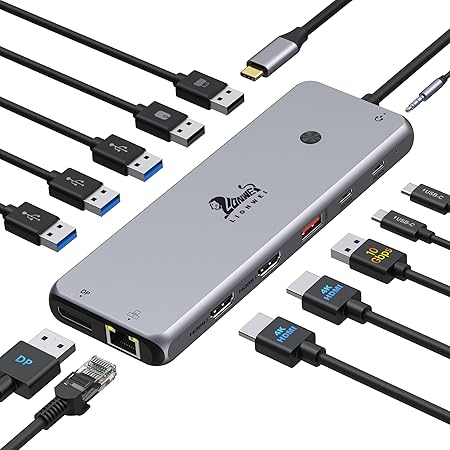
Key Features
- Triple display support via two 4K HDMI ports and one DisplayPort, ideal for multitasking.
- Eight USB ports including two USB-C (up to 10Gbps data and 100W power delivery), USB 3.1, three USB 3.0, and two USB 2.0 for versatile connectivity.
- Gigabit Ethernet for stable wired internet and a 3.5mm audio jack for headphones or mics.
- Plug-and-play design with an 18-month warranty for reliability.
Pros and Cons
- Pros: Extensive port selection reduces need for adapters; supports high-resolution multi-monitor setups on Windows; fast data transfer speeds.
- Cons: Mac users limited to single extended display; power delivery nets about 87W after self-consumption; may generate some heat during heavy use.
Performance & User Experience
In daily use, this docking station shines for office workers or remote setups. Connecting dual 4K monitors on a Windows laptop delivers smooth extend or mirror modes for productivity. Data transfers hit promised speeds for large files, and Ethernet ensures lag-free video calls. Charging keeps laptops powered during long sessions, though Mac users might need workarounds for multi-display. Build feels sturdy, but cable management is key to avoid clutter.
Who Is This Product For?
This is best for Windows laptop users like those with Dell, HP, Lenovo, or Surface who require a portable all-in-one hub for multi-monitor work, peripherals, and stable networking. MacBook owners may find it functional for basics but less optimal for advanced display needs.
Final Verdict
The LIONWEI 13-in-1 USB C Docking Station is a solid choice for boosting laptop versatility, offering great value with its port variety and performance. While not perfect for every OS, it excels where expansion matters most. Consider it if you prioritize connectivity in a single device.
Read More:
- Best Air Fryers for Beginners 2025: Easy Top Picks
- Best Convection Ranges 2025 — Top Picks & Reviews
- 750PSI portable pressure washer review 2026
- Best Vertical Electric Smokers 2025: Ultimate Picks
- Best Range Hoods 2025: Top Picks for Cleaner Kitchens
Buying Guide: How to Choose the best usb c hub for multiple monitors
Types of USB-C Hubs for Multiple Monitors
USB-C hubs for multiple monitors come in various types, primarily differing by their display output capabilities and connectivity standards. Basic models support dual monitors through HDMI or DisplayPort, while advanced ones handle triple or quad setups, often using Thunderbolt for higher bandwidth. Passive hubs rely on the host device’s power, suitable for lighter workloads, whereas powered docks provide independent power for demanding multi-monitor configurations.
Choosing the right type depends on your setup. For office desks with laptops needing extended displays, a dock with multiple video ports offers seamless expansion. Portable hubs suit travelers who connect to hotel screens or projectors on the go, ensuring compatibility with your device’s USB-C capabilities matters for smooth performance.
Understand your monitor count and resolution needs first. This helps avoid underpowered options that limit refresh rates or force compromises in your workflow.
Key Performance Factors
Performance hinges on power delivery, port capacity, data speeds, and video output quality. Look for sufficient Power Delivery (PD) wattage to charge your laptop while running monitors, typically 65W or higher. Port variety—including USB-A, USB-C, Ethernet, and SD slots—expands connectivity without swapping cables.
Video specs like 4K at 60Hz support for multiple displays ensure sharp, fluid visuals. Bandwidth determines if you can run high-res setups without lag, crucial for video editing or multitasking. Compact sizes appeal for portability, but verify heat management for prolonged use.
Match these to your daily tasks. A hub struggling with bandwidth might stutter during presentations, while robust power keeps everything charged and responsive.
Build Quality and Durability
Sturdy construction using aluminum or reinforced plastics withstands daily plugging and unplugging. Aluminum casings dissipate heat better, preventing throttling during extended sessions with multiple monitors. Check for reinforced ports to avoid loosening over time.
Durability ensures longevity in real-world scenarios like office desks or travel bags. Poor materials lead to cracks or connectivity failures, disrupting workflows. Opt for models with ventilation to maintain performance without overheating.
Consider your environment. Frequent movers benefit from lightweight yet rugged builds that resist wear from bags or desks.
Ease of Use and Setup
Plug-and-play functionality simplifies setup for most users, requiring no extra drivers on modern OS like Windows or macOS. Intuitive port layouts and included cables reduce frustration when connecting monitors, keyboards, or drives.
Quick recognition by your device means instant multi-monitor extension. Test compatibility with your laptop’s USB-C version to avoid display issues. Clear labeling on ports aids repeated connections without guesswork.
For beginners, this factor saves hours of troubleshooting, letting you focus on productivity from the start.
Maintenance and Upkeep
Minimal maintenance involves occasional dusting of ports to prevent debris buildup, which can impede connections. Avoid liquid cleaners; use compressed air for internals if accessible. Regular firmware updates, if available, keep performance optimal.
Low-effort designs with no moving parts reduce failure risks. In dusty offices, sealed ports help longevity. Plan for simple wipe-downs after spills to protect electronics.
Easy upkeep translates to reliable daily use without constant interventions, ideal for busy professionals.
Usability Considerations
Fanless designs operate silently, perfect for quiet environments like home offices. Ergonomic shapes with accessible ports prevent cable tangles. Port placement on sides or top eases reaching without flipping the hub.
Comfort in use means stable desk footing and lightweight portability. Overly bulky units crowd workspaces, while slim profiles fit neatly. Heat levels should stay manageable to avoid discomfort near laps.
These details enhance daily interactions, making multi-monitor setups feel effortless rather than cumbersome.
Safety Features
Built-in protections like overcurrent, short-circuit, and overheat safeguards prevent damage to your devices. Auto-disconnect during surges offers peace of mind. Quality components reduce fire risks in powered hubs.
In scenarios with multiple peripherals, these features protect investments. Look for certifications like UL to verify standards compliance. They ensure safe operation even under heavy loads.
Prioritizing safety avoids costly repairs, supporting consistent reliability.
Energy Efficiency
Efficient hubs draw minimal idle power, lowering electricity costs for always-on setups. High PD efficiency means less wasted energy during charging. Low standby consumption suits overnight connections.
For frequent users, this adds up in home or office bills. Efficient designs also run cooler, extending component life. Match to your usage to balance performance and costs.
It’s a practical consideration for eco-conscious buyers or those monitoring expenses.
Warranty and Customer Support
Longer warranties, like 2 years or more, signal manufacturer confidence. Responsive support via email or chat resolves issues quickly. Check return policies for hassle-free exchanges.
Reliable backing addresses rare defects, minimizing downtime. Read user experiences on support speed for realistic expectations. Strong policies build long-term trust.
This factor reassures buyers, ensuring help when needed most.
FAQs
Can a USB-C hub support multiple monitors?
Yes, many USB-C hubs can support multiple monitors if they feature DisplayPort Alt Mode or Multi-Stream Transport (MST) technology. The number of displays depends on the hub’s capabilities, your device’s USB-C port specifications, and the monitors’ inputs. For the best USB-C hub for multiple monitors, verify compatibility with your laptop’s graphics output and the total resolution bandwidth to avoid performance issues. Always check the hub’s documentation for supported configurations.
How many monitors can a typical USB-C hub support?
A typical USB-C hub supports two to three external monitors, though this varies based on the hub’s chipset, USB version (like USB 3.2 or Thunderbolt), and host device limitations. Some advanced models handle four displays with daisy-chaining. When looking for the best USB-C hub for multiple monitors, consider your workflow needs and test resolutions like 1080p or 4K to ensure smooth operation without lag.
What features should I look for in a USB-C hub for multiple monitors?
Key features include HDMI or DisplayPort outputs, support for DisplayPort Alt Mode, MST for multiple streams, and sufficient bandwidth for your resolutions. Additional ports like USB-A and Ethernet add versatility. For the best USB-C hub for multiple monitors, prioritize compatibility with your OS, power delivery for charging, and heat management to maintain reliability during extended use.
Will any USB-C hub work with multiple monitors?
No, not all USB-C hubs support multiple monitors, as this requires specific video output capabilities beyond basic data transfer. Hubs without video passthrough or Alt Mode will only charge or connect peripherals. To find the best USB-C hub for multiple monitors, review specs for display support, Thunderbolt certification if needed, and user reports on real-world multi-display setups.
Does a USB-C hub for multiple monitors need power delivery?
Power delivery (PD) is beneficial but not always required; it allows charging your laptop while powering monitors and peripherals. Hubs with 60W-100W PD prevent battery drain in multi-monitor setups. When choosing the best USB-C hub for multiple monitors, match PD wattage to your device’s needs for uninterrupted productivity, especially with high-resolution displays.
Conclusion
Selecting the right USB-C hub for multiple monitors involves weighing factors like display output support, port variety, compatibility with your device, power delivery, and build quality. This article has explored these elements through comparisons and a buying guide to help clarify options. Remember, no single hub fits every setup—your choice depends on specific needs such as monitor count, resolution requirements, and connectivity demands.
Refer back to the buying guide for personalized criteria and the comparison section for side-by-side insights. By focusing on these aspects, you can make an informed decision tailored to your workflow, ensuring reliable multi-monitor expansion without unnecessary compromises.